Mental Health “Games” Families Play — And How to Break the Pattern
Trauma-Informed Therapy in Mooresville & Lake Norman, NC and the state of North Carolina
If you’ve ever left a family gathering thinking, “How do we always end up here?” — you’re not alone.
Many families unconsciously repeat emotional patterns that once helped everyone survive… but now create conflict, distance, or resentment. At Stafford & Associates Counseling Group in Mooresville, NC, we often call these patterns the “mental health games” families play — not because anyone is manipulative, but because nervous systems fall into familiar roles.
Below, we’ll explore common family dynamics we see across Mooresville, Lake Norman, and the greater Charlotte area — and how therapy helps families shift from reactive cycles to healthy connection.
What Are “Mental Health Games” in Families?
These are repetitive emotional roles and conflict patterns that develop in response to stress, trauma, or attachment insecurity. Over time, they become automatic. In Healing the Adult Children of Narcissists, "Children are seen as reflections of the self" by narcissistic parents—not as individuals with their own needs, thoughts, and identities.
From a schema therapy and attachment perspective, these are survival adaptations — not character flaws.
1. The Blame Game (The Scapegoat Dynamic)
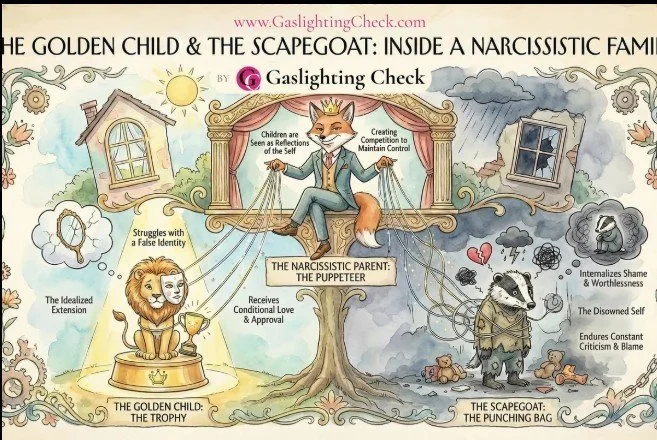
The Golden Child & The Scapegoat: Narcissistic Family
What it looks like:
One family member becomes “the problem.”
All tension funnels toward that person.
Deeper issues (marital strain, unresolved trauma, emotional neglect) stay unaddressed.
In therapy, we often see that the “identified patient” is actually the most emotionally expressive person in the system.
Common outcomes:
Anxiety, anger, embitterment, moral injury
Low self-esteem
Perfectionism or rebellion
Estrangement in adulthood
2. The Rescuer–Victim Cycle (Codependent Pattern)
This dynamic mirrors the Drama Triangle developed by Stephen Karpman.
What it looks like:
One person is chronically overwhelmed.
Another rushes in to rescue.
Resentment builds.
Roles flip during conflict.
Long-term impact:
Lack of autonomy
Emotional enmeshment
Burnout
Chronic guilt
3. The “Don’t Feel” Family
Unspoken rules:
Don’t be too emotional.
Don’t talk about hard things.
Don’t disrupt the image.
This is especially common in families shaped by:
Generational trauma
Military culture
High-performance environments
Faith-based shame narratives
Adult outcomes:
Emotional numbness
Anxiety without language
Fear of intimacy
Conflict avoidance
4. The Moral Superiority Game
What it looks like:
One member is always “right.”
Others feel shamed or corrected.
Control disguises fear.
In high-conflict or narcissistic relational systems, this dynamic can create deep emotional harm.
Results:
Adult children who feel chronically “not enough”
Power struggles in marriage
Difficulty setting boundaries
Why Families Fall Into These Patterns
Families don’t play emotional games because they’re bad people.
They do it because:
The nervous system learned survival strategies early
Attachment felt unstable or conditional
Emotional expression wasn’t safe
Conflict felt threatening
What once protected attachment later prevents intimacy.
How Family Therapy in Mooresville & Lake Norman Helps
At Stafford & Associates Counseling Group, we use:
Schema Therapy
Attachment-Based Therapy
Trauma-Informed Care
Couples & Family Systems Work
Individual therapy
DBT-informed emotional regulation tools
Therapy helps families:
✔ Identify roles without shaming
✔ Understand the unmet emotional needs underneath behavior
✔ Shift from reactive modes to Healthy Adult functioning
✔ Build secure, emotionally responsive relationships
We work with adults, couples, teens, and families throughout:
Mooresville
Lake Norman
Cornelius
Davidson
Huntersville
Greater Charlotte
Signs It May Be Time for Therapy
Repeating the same arguments
One person is always blamed
Emotional shutdown or explosive conflict
Adult children distancing from parents
High-conflict coparenting
Betrayal trauma or relational abuse
Breaking the Cycle Starts With Awareness
The goal is not to label your family. The goal is to increase emotional literacy and build differentiation — the ability to stay connected without losing yourself.
If you recognize your family in these patterns, you are not alone — and change is possible.
Looking for Therapy in Mooresville or Lake Norman?
Stafford & Associates Counseling Group specializes in:
Trauma recovery
High-conflict relationships
Narcissistic or antagonistic dynamics
Betrayal trauma
Attachment and schema therapy
Family conflict repair